
Leeds Book Prize Winner 2025:
Bruce O’Neill (Anthropology, St. Louis University)
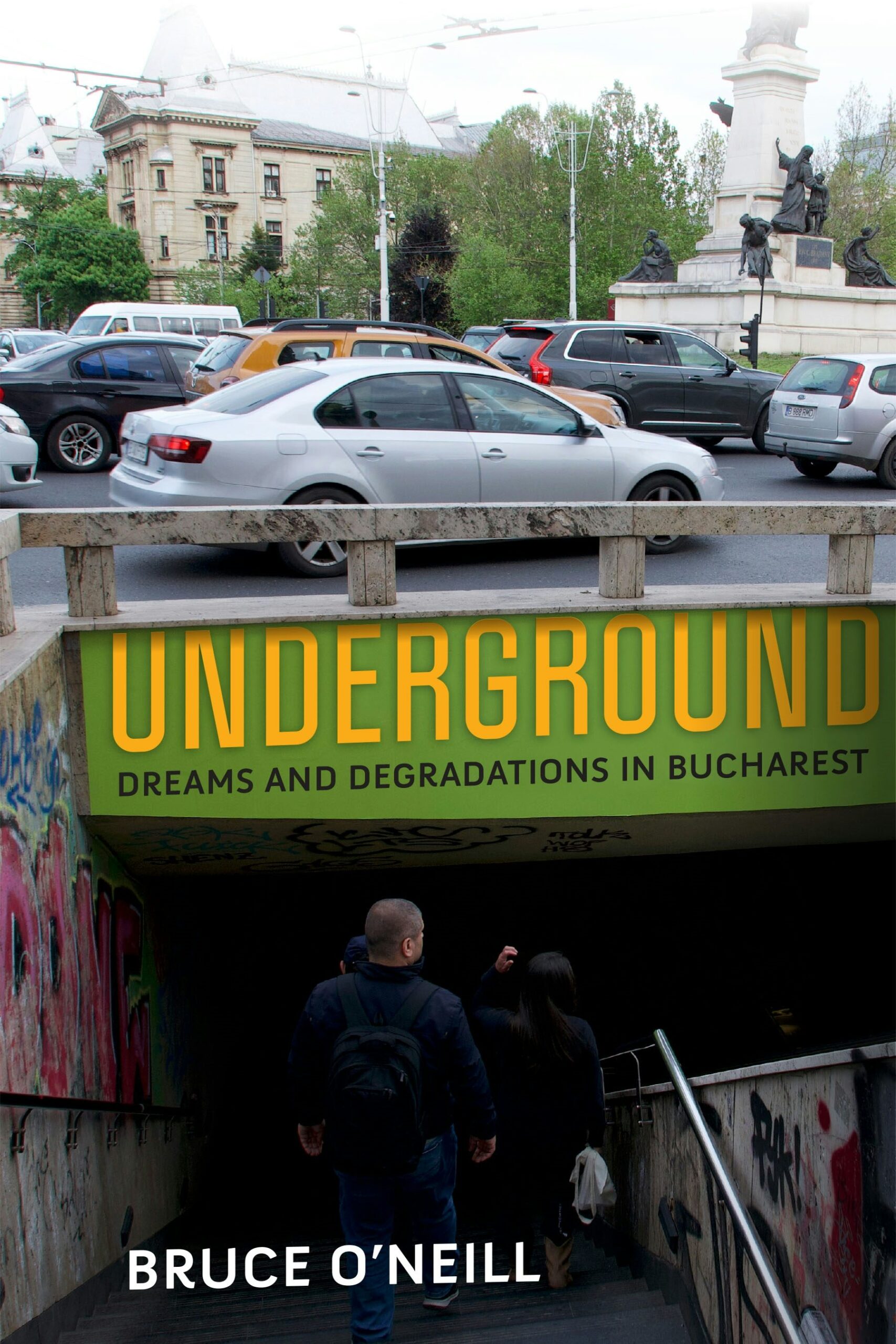 For the best book in urban anthropology published in the previous year, the 2025 CUAA Leeds Book Prize committee awards the Leeds prize to Bruce O’Neill (Anthropology, Saint Louis University), for his book entitled, Underground: Dreams and Degradations in Bucharest, University of Pennsylvania Press, 2024. The Leeds Prize comes with a $500 award.
In Underground, O’Neill provides an original and deeply innovative new approach to urban anthropology in a theoretically ambitious book that argues brilliantly that the pressures of an economically precarious existence for the middle class in Bucharest, Romania, are literally expressed vertically by their being driven “underground.” O’Neill lays out in graphic spatial detail the forces of neoliberal markets and state policies that literally push members of the city’s middle class down under ground, while they favor economic elites who own and live in economically valuable property above ground–often high above ground.
O’Neill shows that altitude matters in a lived and visceral sense of class. Markets and policies discount, disrupt and displace the members of Bucharest’s middle class by pushing them below ground level into precarious existence in their housing, livelihoods, social and leisure time, mobility, health, emotional well-being, and even in their afterlives, as their graves are located far below the crypts of the economic elites who live, thrive and die high above ground. The book is a tour de force of ethnographic imagination and careful methodology, allowing urban anthropologists to derive transposable new insights into their own ethnographic research about the residents of contemporary cities by re-envisioning the relationships between the vertically stratified spaces they live and work in, their class positions, and their life chances under the conditions of late neoliberalism.
Honorable Mentions in 2025 Leeds Book Prize Competition
There are also two books awarded Honorable Mentions in the 2025 Leeds Book Prize competition from among the books submitted to the competition.
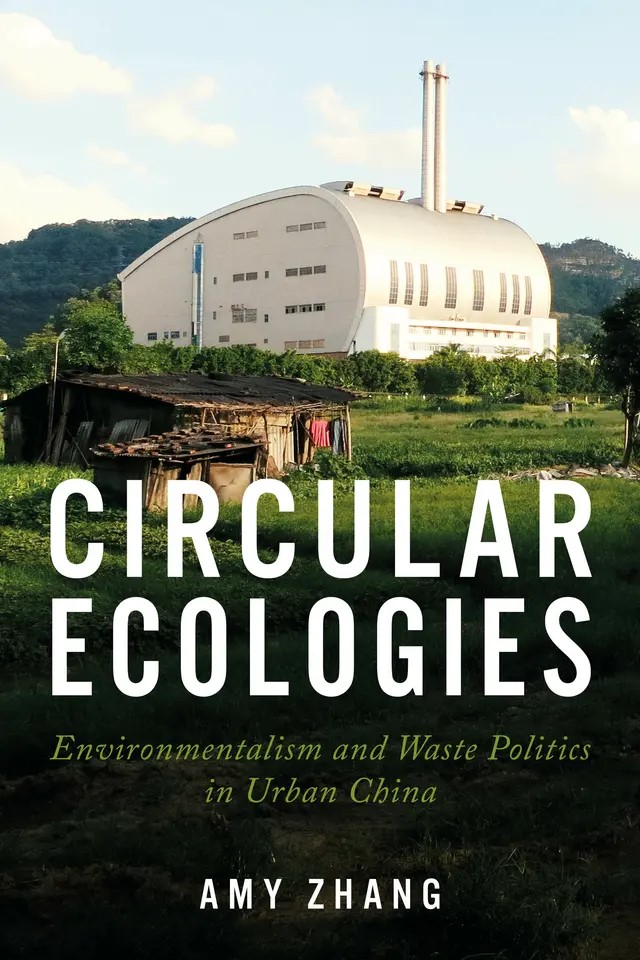
CUAA awards an Honorable Mention for the Leeds Prize to Amy Zhang (Anthropology, New York University) for her book, Circular Ecologies: Environmentalism and Waste Politics in Urban China (Stanford University Press, 2024).
In this wonderfully written book, Zhang explores the ways that China is confronting its domestic waste crisis. Since the 2000s, Chinese policymakers have remade cities with experiments in the circular economy; they have used technological and policy initiatives to convert waste into resources, a circular ecological loop, or so they hoped. Zhang traces ethnographically how this played out in the megacity of Guangzhou. Zhang highlights the limits, limitations and failures of China’s environmental governance and the unexpected rise of grassroots politics and ecological action involving the city’s precarious workers and new middle class residents. The prize committee celebrates Circular Ecologies for Zhang’s intrepid, in-depth ethnographic work, the novelty of the analysis, and its offering to urban anthropology fresh theoretical insights into labor, the urban commons, and the responsiveness to authoritarian rule.
 CUAA awards an Honorable Mention for the Leeds Prize to Joseph Godlewski (Architecture, Syracuse University) for his book, The Architecture of the Bight of Biafra: Spatial Entanglements. Godlewski’s ambitious and well-executed book reconstructs the shaping of architecture and spatial practices in the Bight of Biafra, a coastal region spanning parts of Nigeria, Cameroon, Equatorial Guinea, and Gabon. This process has entailed centuries of entanglements involving the transatlantic slave trade, colonialism, missionary expansion, extractive capitalism, and maritime circulation. The book is a remarkable combination of architectural analysis, archival historiography, and ethnographic spatial reading, as the author skillfully engages both historical archives and field-based spatial observation, blending multi-scalar analysis—from vernacular settlements and religious spaces to ports, plantations, and infrastructures of extraction.
Through its interdisciplinary approach, the book treats the Bight of Biafra as a global spatial formation, shaped by Atlantic trade, colonial mapping, maritime capitalism, and diasporic routes that continues to shape the region as an entangled space. In addition Godlewski’s book is a viewer’s delight with its meticulously designed and informative maps, plans, diagrams and figures. As such, Godlewski’s book represents an outstanding work in urban and transnational anthropology.
The CUAA Leeds Prize Competition Committee for 2025 consisted of Deniz Yonucu (Geography, Politics and Sociology, Newcastle University); Jeff Maskovsky (Anthropology, CUNY Graduate Center); Taku Suzuki (International Studies, Denison University) and Don Nonini, (Anthropology, University of North Carolina).